Farming families in the Atitlán highlands produce sustainably and protect their forests
Project background
The majority of the indigenous rural population in the department of Sololá depend on subsistence farming. 70% of these farming families are poor. The soils of their small fields produce little yield, because they overuse their natural resources. The erosion washes valuable topsoil from the steep slopes into the streams and further into Lake Atitlán, the largest freshwater reserve in Central America.
The mountain cloud forests in the department of Sololá are not only important for the livelihood of the population and for the regional water balance, they are also of national ecological importance for numerous species. However, many farmers are burning woodland to gain new farmland.
Our approach
With our project, we are helping 2,500 small farming families to make their land use more resource-efficient while still improving their crop yields. They learn agroecological farming methods as well as beekeeping and mushroom cultivation that helps them to generate income. They also learn how to use and maintain the forests sustainably. We raise awareness among various groups of the population about resource conservation and support the authorities in implementing organised land-use planning.
Project goals
2,500 farming families have become more resilient and are empowered to manage their natural resources sustainably.
The population’s ability to protect water resources and the environment has been further strengthened.
The village communities use their forests more sustainably.
Farming families use agroecological practices and disseminate them.
Farming families generate additional income through improvements in beekeeping and mushroom cultivation.
Regional approach
The project is part of our Central America regional program, in which we implement projects in the same thematic area in a context-appropriate manner, together with partners in Honduras, Guatemala and Nicaragua. We bring together local experiences and share them with our partners and applied research institutes in regional meetings. Through the shared experiences, we learn from each other to continuously improve our projects at a local level. In addition, we are working with all partners and with the technical support of the CATIE research institute to establish a climate monitoring system that also documents the local impacts of climate change on agriculture, ecosystems and biodiversity in the different project regions.
Project location
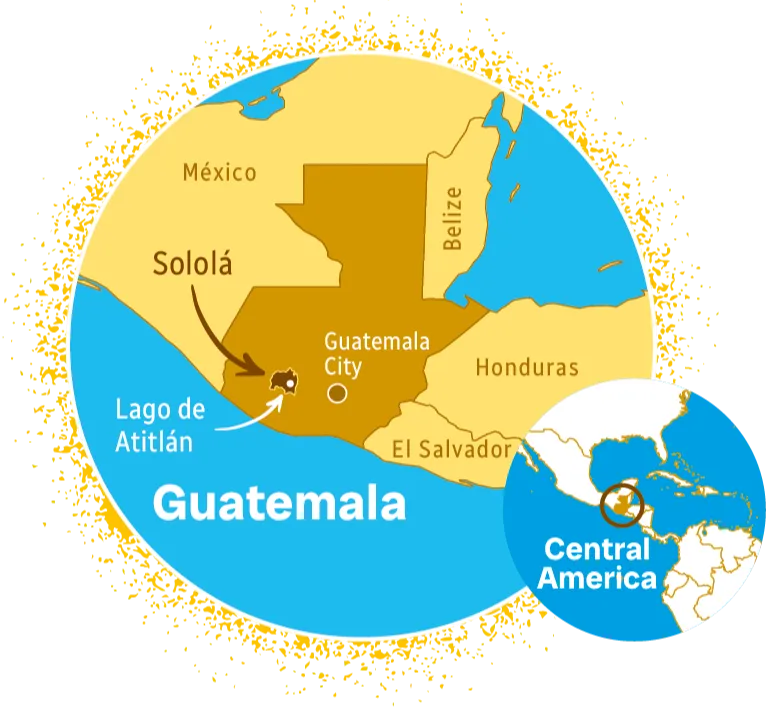
Water shed of the Rio Quiscab and the Zunil-Atitlán-Balam-Juyú volcanic chain. These cover almost the entire department of Sololá in the Atitlán highlands of Guatemala
Topics
Sustainable water and agriculture, protection of natural resources, empowerment
Duration
2024–2027
Target groups
Directly: 22,300 people: 2,500 farming families à 5 people; in addition 1,800 children, estimated 8,000 radio listeners/TV viewers
Indirectly: 25,000 additional residents of the project area
Costs
The project costs are CHF 1,061,170. Own and local contributions are not included in the total costs.
Local project partner
Asociación Vivamos Mejor Guatemala, Panajachel, Guatemala
We received your request and will get back to you as soon as possible.
Unfortunately this did not work!
Your newsletter subscription failed. Please try again.
Stay connected
Discover inspiring stories from our projects and insights into what matters to the communities we support. Our newsletter (published in German) is sent four to six times a year.